• The Luminous Mysteries of the Rosary, also known as the Mysteries of the Light, were introduced by Pope John Paul II in 2002. These mysteries are traditionally prayed on Thursdays.

    1st Luminous Mystery: The Baptism in the Jordan

    • Jesus is baptized by John the Baptist in the Jordan River. The heavens open, the Holy Spirit descends as a dove, and the voice of God the Father proclaims, “This is my Son, my Beloved, with whom I am well pleased”.
    • Think about the significance of Jesus being baptized. Was it necessary? No, however, Jesus gets baptized to set an example for His followers and for us, that we may know Baptism is necessary for salvation. It shows His solidarity with humanity, as He identified Himself with sinners, even though He Himself was sinless.
    • The spiritual fruit of this mystery is openness to the Holy Spirit / becoming a child of God.
    • Matthew 3:16-17 –> “And when Jesus had been baptized, just as he came up from the water, suddenly the heavens were opened to him and he saw the Spirit of God descending like a dove and alighting on him. And a voice from heaven said, “This is my Son, the Beloved, with whom I am well pleased.”

    2nd Luminous Mystery: The Wedding Feast at Cana

    • At a wedding feast in Cana, Mary notices that the hosts have run out of wine. She intercedes with Jesus, who performs His first miracle by turning water into wine, revealing His glory and prompting His disciples to believe in Him.
    • Think about Mary’s role as intercessor here. She becomes aware of a problem, and brings it to her Son, and Jesus then fixes the problem if it is in accordance with His will. This is similar to how Mary acts as our intercessor today.
    • The spiritual fruit for this mystery is fidelity / attentiveness to the needs of others.
    • John 2:3-5 –> “When the wine gave out, the mother of Jesus said to him, “They have no wine.” And Jesus said to her, “Woman, what concern is that to you and to me? My hour has not yet come.” His mother said to the servants, “Do whatever he tells you”.

    3rd Luminous Mystery: The Proclamation of the Kingdom

    • Jesus proclaims the Kingdom of God, calls people to conversion, and forgives the sins of those who draw near to him with trust, inaugurating his ministry of mercy.
    • Think about living in the time of Jesus and listening to Him preach about the Kingdom of God. Would you believe Him? Would you place your trust in Him?
    • The spiritual fruit for this mystery is trust in God.
    • Mark 1:14-15 –> “Now after John was arrested, Jesus came to Galilee, proclaiming the good news of God, and saying, “The time is fulfilled, and the kingdom of God has come near; repent, and believe in the good news.”

    4th Luminous Mystery: The Transfiguration

    • Jesus takes Peter, James, and John to the top of a mountain where he is transfigured before them. His face shines like the sun, and His clothes become a dazzling white. Moses and Elijah also appear, and the voice of God says, “This is my Son, the Beloved; with him I am well pleased; listen to him!”
    • Place yourselves in the shoes of one of the apostles that is here. Imagine after following Him for a while, you hear God the Father’s voice say this about Him. What a special moment this would be.
    • The spiritual fruit for this mystery is courage.
    • Matthew 17:5-6 –> “While he was still speaking, suddenly a bright cloud overshadowed them, and from the cloud a voice said, “This is my Son, the Beloved; with him I am well pleased; listen to him!” When the disciples heard this, they fell to the ground and were overcome by fear”.

    5th Luminous Mystery: The Institution of the Eucharist

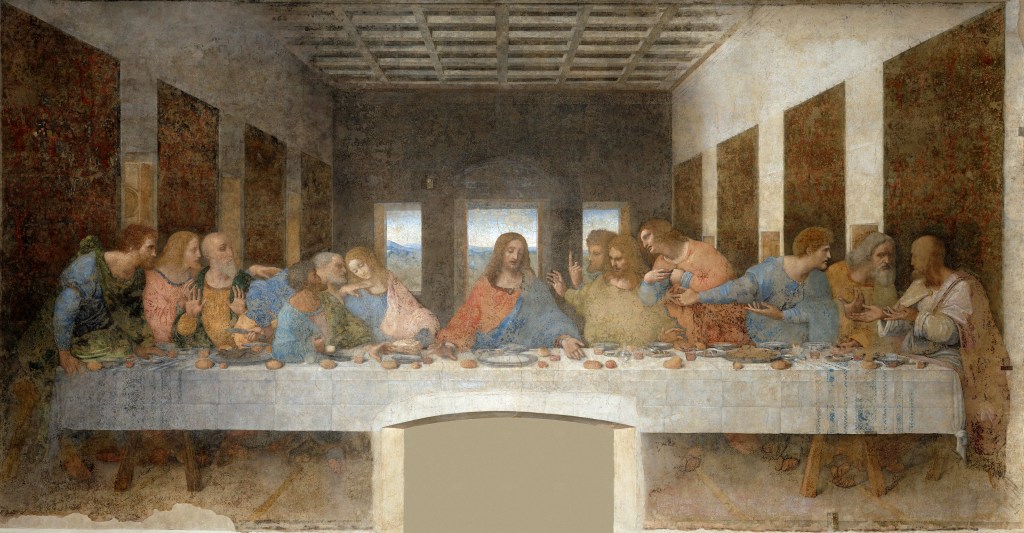
    • At the Last Supper, Jesus offers His body and blood as food and drink under the signs of bread and wine, instituting the Eucharist and demonstrating his love for humanity.
    • Think about what a blessing it is that, roughly 2000 years after the Last Supper, we as Catholics get to participate in this communion with the Lord, where He is truly present in the Eucharist.
    • The spiritual fruit for this mystery is the Love of the Eucharist.
    • Luke 22:19-20 –> “.. and he took bread, gave thanks and broke it, and gave it to them, saying, ‘This is my body given for you; do this in remembrance of me.’ In the same way, after supper he took the cup, saying, ‘This cup is the new covenant in my blood, which is poured out for you”.

    The Luminous Mysteries of the Rosary focus on key events from Jesus’ public ministry, revealing Him as the Light of the World. Personally, my favorite mystery of these is the Institution of the Eucharist. I like to imagine Jesus holding up the bread like the priests do at mass, and how neat it is that over the course of nearly 2000 years we still have the wonderful sacrament of the Eucharist being offered daily at Catholic churches around the world.
    Leonardo da Vinci, Public domain, via Wikimedia Commons

  • The Sorrowful Mysteries of the Rosary focus on the suffering and death of Jesus Christ. These mysteries are traditionally prayed on Tuesdays and Fridays.

    1st Sorrowful Mystery: The Agony in the Garden

    • After the Last Supper, Jesus went with His disciples to the Garden of Gethsemane. Knowing His Passion was near, he withdrew to pray. He experienced intense sorrow while contemplating the suffering He was about to endure. He prayed to His Father, and submitted to His will.
    • This mystery reveals the depth of Jesus’ humanity, and His willingness in suffering for us. It also highlights His obedience for His Father’s will, and His love for us.
    • Put yourself in Jesus’ shoes while praying this mystery. Imagine knowing that in a short while you will be tied to a cross and crucified. Then, remember why you are doing it and who you are doing it for.
    • The spiritual fruit for this mystery is contrition/sorrow for our sins.
    • Matthew 26:36 –> Then Jesus went with them to the place called Gethsemane; and he said to his disciples, ‘Sit here while I go over there and pray.’”

    2nd Sorrowful Mystery: The Scourging at the Pillar

    • After being arrested, Jesus was brought before the Roman governor Pontius Pilate. To appease the crowd, Pilate had Jesus scourged which involved being tied to a pillar and whipped with a leather scourge, often with pieces of bone or metal on it.
    • This mystery represents the physical suffering that Jesus endured for us.
    • Think about Jesus being scourged. Think about how sad of a moment this is. Meditate on what Jesus did for you and for me and for everyone we know.
    • The spiritual fruit for this mystery is purity/mortification of the senses.
    • Matthew 27:26 –> “So he released Barabbas for them; and after flogging Jesus, he handed him over to be crucified.”

    3rd Sorrowful Mystery: The Crowning of Thorns

    • After the scourging, the Roman soldiers mocked Jesus by dressing Him in a robe and placing a crown of thorns on His head. They knelt before Him and said, “Hail, King of the Jews!” They spat on Him and struck Him on the head with a reed.
    • This mystery represents the humiliation and mockery that Jesus endured for us.
    • Think about people spitting on and mocking Jesus. For this mystery, I often meditate on how there are people today who mock Jesus, maybe not in a similar fashion (i.e. spitting on Him), but nevertheless mock Jesus and mock those who believe in Him. Think about how humble Jesus is for sitting there and taking it. He knows what He must do. Personally, this mystery also inspires me to be more humble.
    • The spiritual fruit for this mystery is moral courage/ contempt for the world.
    • Matthew 27:27-29 –> “Then the soldiers of the governor took Jesus into the governor’s headquarters, and they gathered the whole cohort around him. They stripped him and put a scarlet robe on him, and after twisting some thorns into a crown, they put it on his head. They put a reed in his right hand and knelt before him and mocked him, saying, “Hail, King of the Jews!”

    4th Sorrowful Mystery: The Carrying of the Cross

    • After the mockery, Jesus was forced to carry His own cross to Calvary, the crucifixion site. Weakened by the scourging, He struggled under the weight of the cross.
    • This mystery represents the burden of sin that Jesus took upon Himself for our redemption. It also highlights His perseverance and determination to do the Father’s will.
    • Imagine watching Jesus, beaten and bloody, struggling to carry His cross to where he was about to be killed. The site of this would be quite unsettling.
    • The spiritual fruit for this mystery is patience in adversity / bearing wrongs patiently.
    • Matthew 27:31-32 –> “After mocking him, they stripped him of the robe and put his own clothes on him. Then they led him away to crucify him. As they went out, they came upon a man from Cyrene named Simon; they compelled this man to carry his cross.”

    5th Sorrowful Mystery: The Crucifixion

    • At Calvary, Jesus was nailed to the cross. He hung there for three hours, enduring intense physical and spiritual agony. He was mocked by people around, yet he remained steadfast in His mission.
    • This is the ultimate expression of Jesus’ love. He died for us so that we might be saved. The ultimate sacrifice one could give someone is themself.
    • Imagine watching Jesus get nailed to a cross for you. What a sacrifice.
    • The spiritual fruit for this mystery is love for enemies.
    • Matthew 27:33-35 –> “And when they came to a place called Golgotha (which means Place of Skull), they offered him wine to drink, mixed with gall; but when he tasted it, he would not drink it. And when they had crucified him, they divided his clothes among themselves by casting lots.”

    The Sorrowful Mysteries are the most intense and emotional set of mysteries on the Rosary. Personally, they are my favorite because I have the most emotional response to them, and I can truly feel the connection with Jesus when I pray these. It is a perfectly linear sequence of events that outline Christ’s passion. Praying the Sorrowful Mysteries regularly is a good practice because it reminds you of what Christ’s sacrifice and Passion was. When you really sit there and meditate on these mysteries, the realization of Christ’s love for us hits you like a ton of bricks. What a sacrifice for you and for me.

    Hendrick ter Brugghen, Public domain, via Wikimedia Commons

  • The Glorious Mysteries focus on the events following Jesus’ Resurrection, highlighting His triumph over death and the glory of Mary. Traditionally, these mysteries are prayed on Sundays and Wednesdays.

    1st Glorious Mystery: The Resurrection

    • This mystery celebrates Jesus’ victory over death and sin, offering hope for our own resurrection and eternal life.
    • Mary Magdalene and other women went to the tomb and found it empty. Jesus appeared to Mary Magdalene, and later to other disciples, showing them the wounds in his hands and sides to prove that it was truly him.
    • Think about what it would feel like to see Jesus after you knew He died.
    • The spiritual fruit for this mystery is faith.
    • Luke 24:6-7 –> “He is not here, but has risen. Remember how he told you, while he was still in Galilee, that the Son of Man must be handed over to the hands of sinners, and be crucified, and rise on the third day.”

    2nd Glorious Mystery: Jesus Ascends into Heaven

    • This mystery commemorates Jesus’ ascension into heaven, where He sits at the right hand of the Father. It fills us with hope that we too will one day share in His glory.
    • Forty days after His Resurrection, Jesus led his disciples to the Mount of Olives. There, He gave them final instructions, promising that they would receive power when the Holy Spirit came upon them. As they watched, He was taken up into heaven, and a cloud hid Him from their sight. This marks the end of Jesus’ earthly ministry and the beginning of His reign in heaven.
    • Think about being briefed by Jesus with instructions on how to carry His glory on after He leaves to return a heaven.
    • The spiritual fruit for this mystery is hope.
    • Luke 24:50-51 –> “Then he led them out as far as Bethany, and, lifting up his hands, he blessed them. While he was blessing them, he withdrew from them and was carried up into heaven.”

    3rd Glorious Mystery: The Descent of the Holy Spirit

    • This mystery celebrates the coming of the Holy Spirit upon the apostles, empowering them to preach the Gospel and spread the love of God.
    • On the day of Pentecost, the apostles were gathered in the Upper Room when suddenly a sound like a rushing wind filled the house. Tongues of fire appeared and rested on each of them, and they were filled with the Holy Spirit. This moment is significant since it marks the birth of the Church and the empowerment of the apostles to carry out their mission.
    • Think about being filled with the Holy Spirit and then being motivated to preach to all you see about the Gospel, and what you experienced with Jesus.
    • The spiritual fruit of this mystery is love of God/wisdom/divine charity.
    • Acts 2:2-4 –> “And suddenly from heaven there came a sound like the rush of a violent wind, and it filled the entire house where they were sitting. Divided tongues, as of fire, appeared among them, and a tongue rested on each of them. All of them were filled with the Holy Spirit and began to speak in other languages, as the Spirit gave them ability.”

    4th Glorious Mystery: The Assumption of Mary

    • This mystery commemorates Mary’s assumption into heaven, body and soul. It is a sign of hope for all believers, as it shows that we too can share in the glory of heaven.
    • The Assumption is the belief that at the end of her earthly life, Mary was taken up body and soul into heaven. This was a unique privilege granted to Mary because of her Immaculate Conception and her role as the Mother of God.
    • Think about Mary’s unique role in salvation history as the Mother of God.
    • The spiritual fruit for this mystery is union with Christ/eternal happiness.
    • While the Assumption of Mary is not explicitly stated in Scripture, the Church teaches it as a truth deeply rooted in both Sacred Tradition and biblical reflection. Mary, as the sinless Mother of God and Ark of the New Covenant, was assumed body and soul into Heaven as a fitting end to her earthly life. This belief, held by Christians since the early centuries, was formally defined as dogma by Pope Pius XII in 1950. *I will make posts about Marian Dogmas in the future!

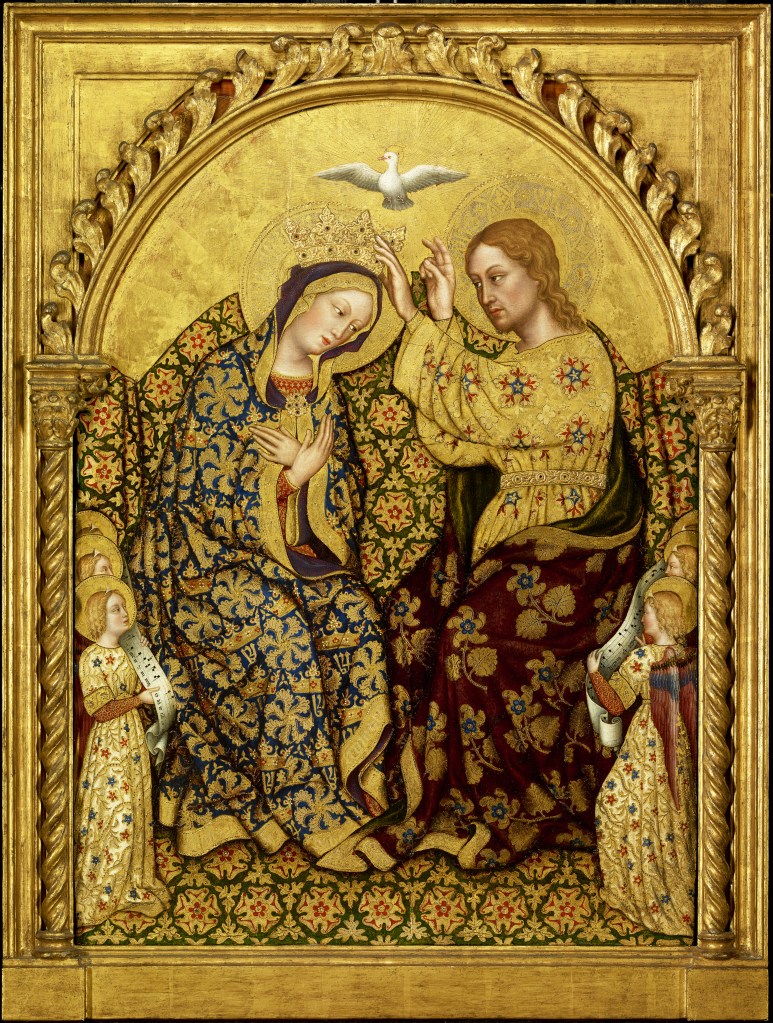
    5th Glorious Mystery: The Coronation of Mary as Queen of Heaven and Earth

    • This mystery celebrates Mary’s coronation as Queen of Heaven and Earth. It recognizes her unique role in salvation history and her powerful intercession for us.
    • Having completed her earthly journey and been assumed into Heaven, Mary is now exalted and crowned with glory. She reigns as a loving Mother and intercessor, always pointing souls towards her Son.
    • Think about witnessing Mary being crowned as Queen of Heaven and Earth by her Son.
    • The spiritual fruit for this mystery is perseverance/filial devotion to Mary
    • While not described in a single Bible verse, this mystery is supported by Scripture and Tradition. In the Old Testament, the mother of the king held a place of honor, and in Revelation 12:1, we see “a woman clothed with the sun… and on her head a crown of twelves stars.”. Mary’s queenship naturally flows from her Assumption, and the Church celebrates her as Queen not by her own power, but by the grace of her Son.

    When praying these mysteries, try and envision yourself present in each scene. Meditate on the importance of each event, and what it means for us as Christians.

    Gentile da Fabriano, Public domain, via Wikimedia Commons

  • The Joyful Mysteries of the Rosary focus on the early life of Jesus and the events surrounding His Incarnation. Traditionally, these mysteries are prayed on Mondays and Saturdays. They invite reflection on the joy and anticipation surrounding the coming of the Messiah.

    1st Mystery: The Annunciation

    • The Angel Gabriel announces to Mary that she will conceive a son, Jesus, and He will be Son of the Most High.
    • It highlights Mary’s “yes” to God’s call, her fiat, which made it possible for the Incarnation.
    • Think about the importance of Mary’s “yes”.
    • The spiritual fruit of this mystery is Humility. We are invited to imitate Mary’s humility in accepting God’s will, even if it is difficult to understand. It encourages us to recognize our own nothingness before God and to be open to His grace.
    • Luke 1:28-31 –> “And he came to her and said, “‘ Greetings, favored one! The Lord is with you!’ But she was much perplexed by his words and pondered what sort of greeting this might be. The angel said to her, ‘Do not be afraid, Mary, for you have found favor with God. And now, you will conceive in your womb and bear a son, and you will name him Jesus.’”

    2nd Mystery: The Visitation

    • This mystery recalls Mary’s visit to her cousin Elizabeth, who was also pregnant with John the Baptist.
    • It celebrates the encounter between the two expectant mothers and the recognition of Jesus as the Messiah by John, who leaped in Elizabeth’s womb.
    • Think about the significance of John leaping in his mother’s womb at the presence of Jesus, who is also in His mother’s womb.
    • The spiritual fruit of this mystery is charity. We are invited to imitate Mary’s charity in reaching out to help others in need. It reminds us to be attentive of the needs of our neighbors and to offer them practical assistance and spiritual support.
    • Luke 1:41-42 –> “When Elizabeth heard Mary’s greeting, the child leaped in her womb. And Elizabeth was filled with the Holy Spirit and exclaimed with a loud cry, ‘Blessed are you among women, and blessed is the fruit of your womb!’”

    3rd Mystery: The Nativity

    • This mystery commemorates the birth of Jesus in a stable in Bethlehem.
    • It highlights the humility and poverty of Jesus’ birth, as well as the joy and wonder of the angels and shepherds who came to adore Him.
    • Think about the poverty of the situation. Jesus is born in an old barn stable, and there is no space for Him in the inn.
    • The spiritual fruit of this mystery is poverty/detachment from the things of the world. It encourages to detach ourselves from material possessions and to focus on spiritual riches.
    • Luke 2:7 –> “And she gave birth to her firstborn son and wrapped him in bands of cloth, and laid him in a manger, because there was no place for them in the inn.”

    4th Mystery: The Presentation

    • This mystery recalls Mary and Joseph taking Jesus to the Temple in Jerusalem and to present Him to God, according to Jewish custom.
    • Simeon recognizes Jesus as the Messiah.
    • Simeon also foreshadows the sacrifice of Jesus for the salvation of humanity. He said that Jesus would be a “sign of contradiction” and that a sword would pierce Mary’s heart.
    • Think about Simeon’s joy at seeing the Messiah, something he has waited for his entire life.
    • The spiritual fruit of this mystery is obedience to God’s will/purification. We are called to imitate Mary and Joseph’s obedience to God’s law in presenting Jesus to the Temple. It reminds us to be obedient in all things and seek purification from sin.
    • Luke 2:22-24 –>”When the time came for their purification according to the law of Moses, they brought him up to Jerusalem to present him to the Lord (as it is written in the law of the Lord, ‘Every firstborn male shall be designated as holy to the Lord’), and they offered a sacrifice according to what is stated in the law of the Lord, ‘a pair of turtledoves or two young pigeons.’”

    5th Mystery: The Finding of Jesus in the Temple

    • This mystery commemorates the time when Jesus, at the age of twelve, was lost by Mary and Joseph during a pilgrimage to Jerusalem. After three days of searching, they found Him in the Temple, sitting among teachers, listening and asking questions.
    • It reveals Jesus’ growing awareness of His divine mission and His dedication to His Father’s will.
    • Think about what Mary and Joseph must have been going through when they could not find Jesus. Then, think about the joy they feel when they find Him in the Temple.
    • The spiritual fruit of this mystery is zeal for God’s glory/ true wisdom. It invites us to imitate Jesus’ zeal for His Father’s house and His desire to learn about God.
    • Luke 2:46-47 –> “After three days they found him in the temple, sitting among the teachers, listening to them and asking them questions. And all who heard him were amazed at his understanding and his answers.”

    The Joyful Mysteries are a beautiful set of five events from Jesus’ early life. While praying through the decades, place yourself in the scene. Perhaps you want to place yourself in Mary’s shoes, or in Joseph’s shoes. Try and become one with the moment. Witness what is happening in each of these events, and try to understand the importance and significance of each scene.

    Attached below is an apostolic letter from Pope John Paul II covering the Joyful Mysteries:


    Lorenzo Monaco
    , CC0, via Wikimedia Commons

  • The Rosary is a traditional Catholic prayer that combines vocal prayer with meditation on the mysteries of Christ’s life and the role of the Virgin Mary in salvation history. It is one of the most beloved and powerful devotions in the Catholic Church. It leads us deeper into the life of Christ through the eyes of His Mother. For centuries, countless saints, popes, and faithful Catholics have turned to the Rosary for strength, peace, and grace.

    Brief History of the Rosary:

    The Rosary’s origins can be traced back to the practice of reciting Psalms in the early Church. Early Christians and monks used knotted ropes or pebbles to count prayers, especially the 150 Psalms. Many lay people were unable to read, so instead they would recite 150 Our Fathers or Hail Marys. This became known as the “Poor Man’s Psalter”. Tradition holds that in 1214 in southern France, St. Dominic received the Rosary in a vision from Our Lady to help combat the Albingensian heresy and sin. She gave it as a spiritual weapon, encouraging the faithful to meditate on the life of Christ while praying Hail Marys. The Rosary, as it is known today, was formalized in the 15th century by the Dominican order.

    Purpose of Praying the Rosary:

    The Rosary is far more than the repetition of prayers. It is a contemplative journey through the Gospel. In the words of Pope John Paul II, “the Rosary is a compendium of the Gospel”.

    • Contemplation of the mysteries of salvation.
    • To encourage practical reflection on the life of Christ.
    • Mary, our most powerful intercessor, takes our intentions to her Son.
    • To form the virtues of humility, charity, purity, patience, and faith.
    • The Rosary is a spiritual weapon. Countless saints have testified to its power against temptation and evil.

    Structure of the Rosary:

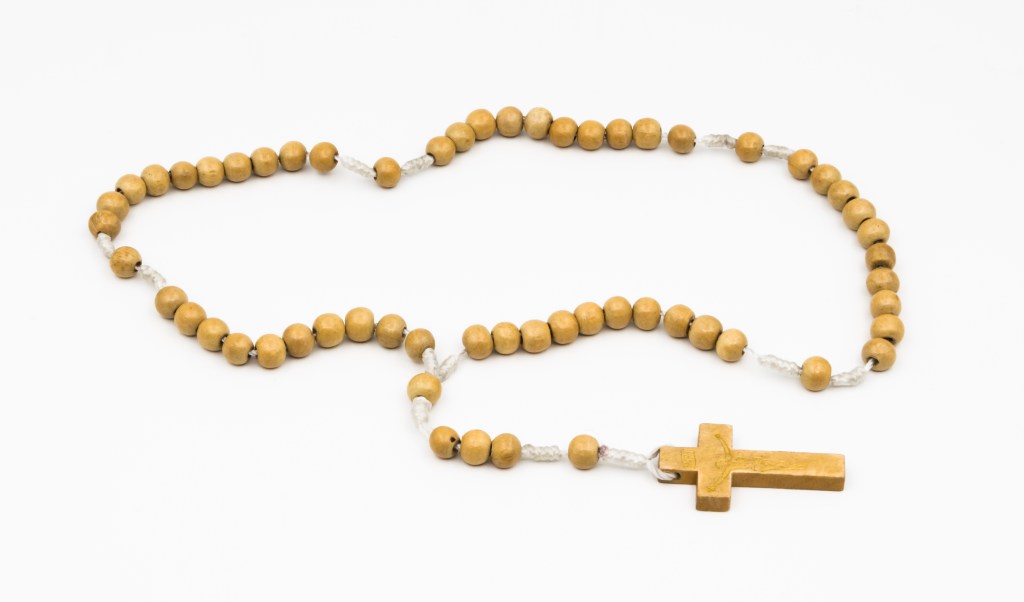
    A standard Rosary consists of a crucifix, 5 decades, and a set of opening prayers.

    1. Holding the Crucifix, do the sign of the cross, then say the Apostles’ Creed
    2. On the next bead after the Crucifix, say an Our Father
    3. On the following three beads, say a Hail Mary on each
    4. On the next bead, say a Glory Be
    5. Next you start the first of five decades. You announce the mystery, say an Our Father, then on the following ten beads (one decade = ten beads) you say a Hail Mary on each, contemplating the mystery.
    6. After the tenth Hail Mary, you say a Glory Be and many say a Fatima prayer.
    7. Move to the next large bead and repeat steps 5-6 for the next decade.
    8. At the end of the five decades, you will have worked your way around the Rosary back to the starting place of the first decade. End with a Hail Holy Queen, and perhaps an optional prayer like a St. Michael, then do the sign of the cross and you are done.

    The Mysteries of the Rosary:

    One thing I mentioned above was this word “mystery”. The mysteries of the Rosary are sets of moments that you meditate on while you pray. There are four sets of mysteries: the Joyful Mysteries, Sorrowful Mysteries, Glorious Mysteries, and Luminous Mysteries. I will be making blog posts specific to each set of mysteries with more information, but essentially within each set of mysteries there are five decades (five events) that you contemplate and meditate on while you say your Hail Marys. Let me give you an example of what I mean when I say “meditate on the mysteries”. Let us use the third Joyful Mystery, the Nativity of Jesus, as an example. While you are praying the ten Hail Marys, imagine yourself in the manger as Mary gives birth to Jesus. Picture yourself there with her and Joseph. Put yourself in the scene, and really think about the significance of what is happening. Pretend you are a bystander witnessing the event. What is happening? What are you seeing? That is meditation upon to the mysteries. From the names, you can infer as to what the tone is for each set of mysteries. For example, the Joyful Mysteries are five events from the Gospel that are joyful, the Sorrowful Mysteries contain five events from the Gospel that are sorrowful etc.

    Saints/Popes and the Rosary:

    Here are a handful of some of the many powerful quotes and testimonies from faithful Catholics over the years regarding the Rosary:

    “Say the Rosary every day. Pray it with devotion. There is no problem, no matter how difficult… that cannot be solved by the power of the Rosary”. – Sister Lucia of Fatima

    “The Rosary is a powerful weapon to put the demons to flight and to keep oneself from sin”. – St. Louis de Montfort

    “The Rosary is a weapon for these times”. – St. Padre Pio

    “The Rosary is the most beautiful and the most rich in graces of all prayers; it is the prayer that touches most the Heart of the Mother of God… and if you wish peace to reign in your homes, recite the family Rosary”. – Pope Pius XII

    “The Rosary is a powerful weapon to put demons to flight and to keep oneself from sin… If you desire peace in your hearts, in your homes, and in your country, assemble each evening to recite the Rosary. Let not even one day pass without saying it, no matter how burdened you may be with many care and labors”. – Pope Pius XI

    Final Reflection:

    As you can see, the Rosary has proven to be a powerful devotion in the Church. Of course, by no means is it required for Catholics to pray, however it is a great prayer to recite and it is highly encouraged. Personally, I am pleased to say that starting on January 1 of this year, I have prayed the Rosary without missing a day. It has turned into something I look forward to each day, and I can feel and see the graces flowing from it. It is important to realize though that each time you pray it, there is not going to be some complex, life-changing revelation. Prayer life is far from that. Despite countless amazing testimonies from saints throughout the ages, the day to day prayer life can feel mundane sometimes. That is ok! It is part of the process. The Christian way of life is a grind. We have to put the work in each day, and it often takes a while to see the fruits of your work. The important part is staying consistent and trusting in God. When I first started praying the Rosary last year after coming back to the faith, it felt like a job at times. I got bored quickly sitting there for twenty minutes alone reciting the prayers. My mind would often wander to other things. That may happen to you as well if you decide to begin to start praying, and that is ok. A practical suggestion I have is to start bit by bit. For example, a priest I know prays his Rosary daily, but he spreads the decades out throughout the day. One decade in the morning, one at lunch, etc. Get creative! Perhaps it would be more beneficial for you to just pray one decade a day until you get the swing of things. Figure out what works best for you, stick with it, and stay consistent. Also, you do not have to sit alone in a dark and quiet room to pray it. For some that may be ideal, however if you have trouble sitting in silence like that, I recommend praying it while on a walk, while driving, in adoration, or in line for confession. Remember, God will be happy to see the effort you are putting in! I truly recommend a daily Rosary as I have seen the benefits of adding it to my daily routine, however that can be daunting at first when you are starting out. Thus, try and come up with a game plan, pray to the Lord for strength to stay consistent, and over time you can add more and more to your routine. The Rosary is a gift. It is a spiritual lifeline offered by the Blessed Mother to draw us into the heart of her Son. In a world of noise and anxiety, it is a prayer of peace, clarity, and grace.

    Jacek Halicki, CC BY-SA 4.0 https://creativecommons.org/licenses/by-sa/4.0, via Wikimedia Commons

    Note: Notice the structure of the Rosary. You have your cross (crucifix on most Rosaries) where you say the Apostle’s Creed, then you have a standalone bead where you say the Our Father, then three beads together for three Hail Marys, then another standalone bead where you say the Glory Be and start the first decade. Notice the five sections of ten beads. These are the decades. Ten Hail Marys. Each standalone bead around the Rosary is the beginning of a new decade.

    Titian, Public domain, via Wikimedia Commons

    A painting of St. Dominic by Renaissance painter Titian

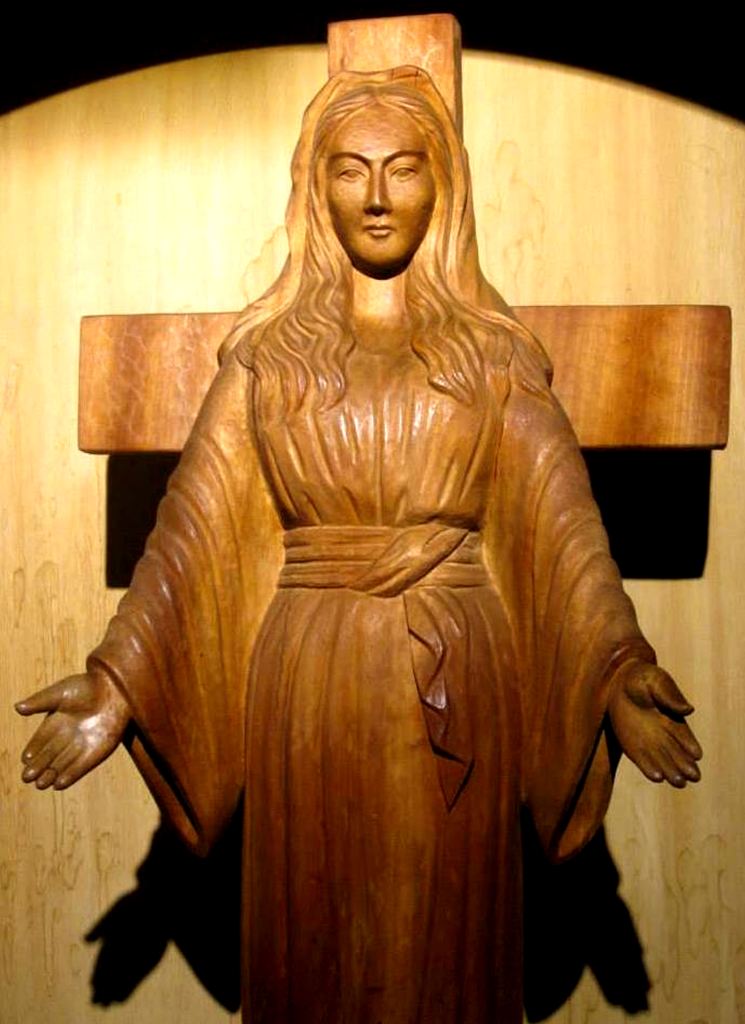
  • Our Lady of Akita was a Marian apparition reported in 1973 by Sister Agnes Katsuko Sasagawa in Akita, Japan. Sister Agnes was a Japanese nun at the Institute of Handmaids of the Holy Eucharist in Akita. She experienced health problems, including deafness.

    On June 12, 1973, Sister Agnes saw luminous beings around the altar in church. Sister Agnes saw her guardian angel and a three-foot-high wooden statue of the Virgin Mary ablaze with light. The statue of the Virgin Mary reportedly wept, bled, and sweated. This phenomenon was witnessed by other people, and the blood was tested and confirmed that it was human blood.

    The Virgin Mary gave several messages to Sister Agnes including warnings of impending calamities, and calls for prayer, penance, and conversion. Sister Agnes’s deafness was reportedly healed as well.

    This apparition serves as a reminder for us to maintain a strong prayer life, to constantly repent, and to remain faithful to the teachings of Christ.

    SICDAMNOME, CC BY-SA 4.0 https://creativecommons.org/licenses/by-sa/4.0, via Wikimedia Commons
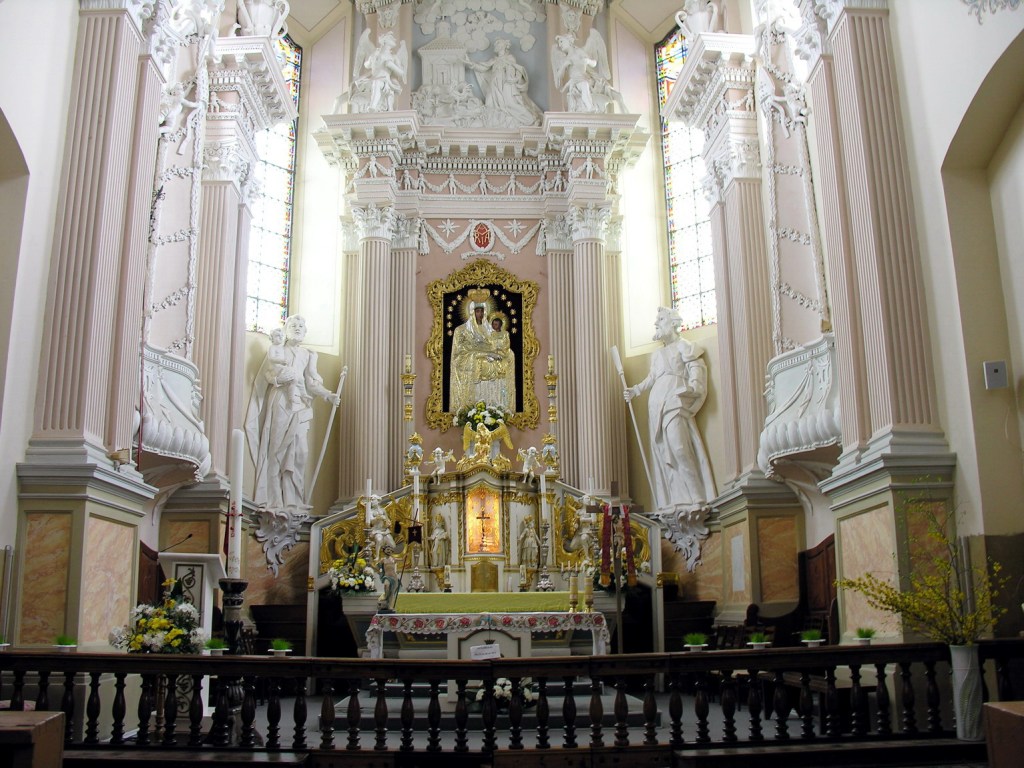
  • Our lady of Šiluva was a Marian apparition that occurred in the early 17th century in Šiluva, Lithuania. In the 16th century, the Protestant Reformation spread across Europe, and Lithuania was not untouched by these religious changes. Many Catholic lands were seized, and some of the population converted to Calvinism.

    In 1608, shepherds in the area reported seeing a woman weeping and holding a baby in a field in Šiluva. She was asked why she was weeping and she responded, ” Formerly in this place, my Son was worshipped, but now people plow and sow.” The apparition led to the discovery of a buried chest containing Catholic treasures, including a painting of the Virgin Mary with the infant Jesus, the original Church’s deed, and other valuables. These items had been hidden by the parish priest during the Reformation to protect them from desecration.

    Many people in the region saw this as a sign from God, reaffirming the importance of the Catholic faith. It played a significant role in the conversion of many people back to Catholicism. Our Lady of Šiluva is considered of symbol of Lithuania’s Catholic faith throughout centuries of challenges.

    The image of Our Lady of Šiluva is a painting of the Virgin Mary holding the infant Jesus. It serves as a reminder of the importance of our Catholic faith.

    Algirdas at the Lithuanian language Wikipedia, CC BY-SA 3.0 http://creativecommons.org/licenses/by-sa/3.0/, via Wikimedia Commons
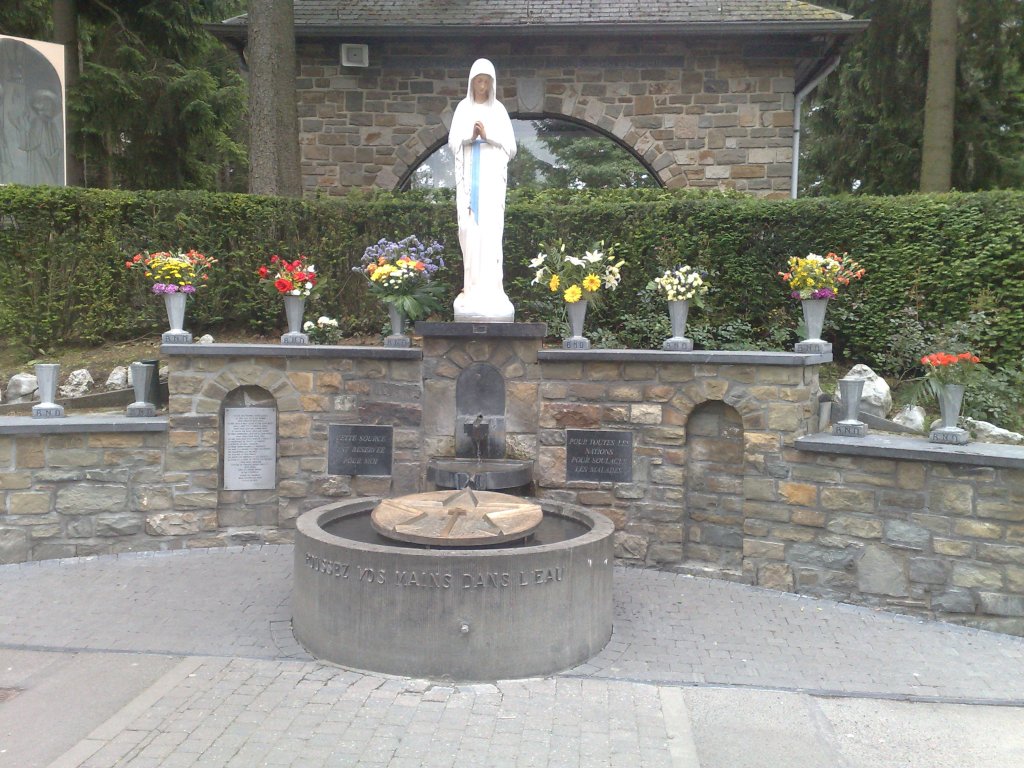
  • Our Lady of Banneux, or Our Lady of the Poor, refers to a set of Marian apparitions that took place in Banneux, Belgium, in 1933. Mariette Beco was a 12-year-old girl from a working-class family, and she was not particularly religious at the time of the apparitions. Between January 15 and March 2, 1933, Beco reported seeing 8 apparitions of the Virgin Mary in her family’s garden.

    On January 15, Beco saw a luminous figure of a lady standing in the garden. The lady beckoned her to come closer, but Beco’s mother prevented her from going outside. In subsequent apparitions, Beco went outside and knelt before her. Mary identified herself as the “Virgin of the Poor”. During several apparitions, the Virgin Mary took Beco to a small spring in the woods and told her that the spring was reserved for all nations, to heal the sick.

    The Virgin Mary conveyed several messages to Beco including:

    • “Believe in me, and I will believe in you”
    • “This spring is reserved for all nations… for the relief of the sick”
    • “I am the Virgin of the Poor”
    • “I am the Mother of the Savior, Mother of God”

    Beco underwent numerous medical and psychological examinations, and in 1949, Bishop Louis-Joseph Kerkhofs of Liège officially recognized the apparitions.

    Our Lady of Banneux brought a message of hope and comfort during a time of economic hardship and social unrest. The title “Virgin of the Poor” emphasizes Mary’s concern for the marginalized and those in need, and serves as a reminder for us to help those in need. The spring continues to flow to this day, and many attribute healing powers to it.

    Johfrael, CC BY-SA 3.0 https://creativecommons.org/licenses/by-sa/3.0, via Wikimedia Commons
  • Our Lady of Beauraing was a series of apparitions that took place in Beauraing, Belgium, between November 29, 1932, and January 3, 1933. These apparitions were witnessed primarily by five children from local families. The five children who reported seeing the apparitions were: Fernande Voisin, 15, Gilberte Voisin, 13, Albert Voisin, 11, Andrée Degeimbre, 14, and Gilberte Degeimbre, 9.

    On November 29, 1932, Fernande and Andrée were waiting for their siblings near a local convent school. Suddenly, they saw a figure walking above the nearby railway bridge. They described the lady as being young and beautiful, dressed in a long white robe with a blue sheen, and wearing a crown of golden light. Over time, the Virgin Mary often appeared near a hawthorn tree in the garden of the school.

    During the apparitions, the Virgin Mary conveyed several messages to the children, emphasizing the importance of prayer, faith, and sacrifice. Her messages included:

    • “Always be good” – this was one of the most repeated messages.
    • “Pray always”
    • “Do you love my Son?”
    • “I am the Immaculate Virgin”

    During the final apparition, the Virgin Mary requested that a chapel be built in Beauraing. As is the case with all reported apparitions, the local bishop, Mgr. André-Marie Charue, established a commission to investigate the events. They thoroughly examined the children’s accounts and their psychological states. Finally, 10 years later in 1943, the local bishop authorized devotion to Our Lady of Beauring.

    Our Lady of Beauraing serves as a gentle reminder to live out basic Christian virtues. We are reminded to always be good, to always pray, and to love our Lord more than anything.

    Donarreiskoffer, CC BY-SA 4.0 https://creativecommons.org/licenses/by-sa/4.0, via Wikimedia Commons
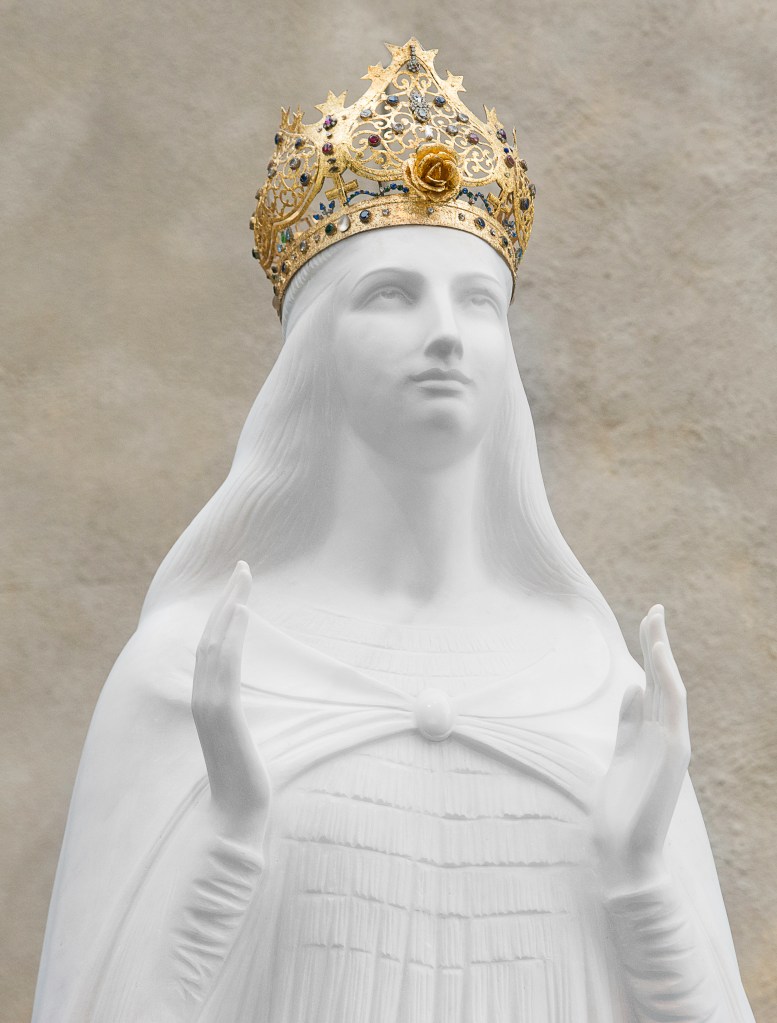
  • Our Lady of Knock was a set of apparitions that took place in 1879, is the small village of Knock, County Mayo, Ireland. This is one of the more unique Marian apparitions since it was viewed by a group of villagers rather than a single visionary.

    The late 19th century was a time of economic hardship and social upheaval in Ireland, marked by poverty, famine, and political unrest. Around 8:00 PM on August 21, 1879, several villagers were passing by the parish when they noticed something unusual. Two women, Mary McLoughlin and Mary Beirne were the first to report seeing an apparition of the Virgin Mary, St. Joseph, and St. John the Evangelist. They also saw a lamb on an altar before the cross.

    These figures were life-sized and were described as being radiant. The Virgin Mary was wearing a white robe and a crown. St. Joseph stood to her right with his head bowed in reverence. St. John the Evangelist stood to her left, holding a book. The lamb represents Jesus Christ, the Lamb of God, sacrificed for the salvation of humanity.

    Interestingly, the apparitions never spoke. The apparition was entirely silent, adding to its mysterious nature. Fifteen official witnesses, ranging in age from young children to elderly adults, were interviewed by Archbishop John MacEvilly, and their testimonies confirmed the details of the apparition.

    Similar to many other Marian apparitions, Mary appeared to the people of Knock during a time of hardship and suffering, offering a silent message of hope and comfort to the Irish people. We are reminded of the power of faith, importance of prayer, and the enduring presence of the Blessed Virgin Mary in our lives who is there to intercede for us.


    Michael McLaughlin Photography
    CC BY-SA 4.0, via Wikimedia Commons